BIONANO 60325 Saphyr Optical Genome Mapping Structural Variant Detection
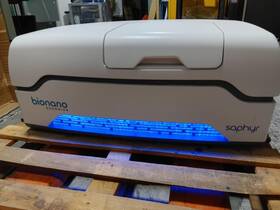
( Brand: Bionano ), ( Manufacturer Part Number: 60325 ), ( Unit Type: Unit ), ( Intended Use/discipline: Biological Laboratory, Veterinary Medicine )
Review BIONANO Saphyr Optical Genome Mapping System Structural Variant Detection
The Bionano Genomics Saphyr System is a revolutionary optical genome mapping (OGM) platform designed for the detection of structural variants (SVs) in genomes. The Bionano 60325 Saphyr Kit is a key component of this system, providing all the necessary reagents and consumables for performing SV detection experiments.
The Saphyr System utilizes Bionano's proprietary linear DNA labeling and nanopore-based imaging technology. During the labeling process, the DNA is converted into a linear form using the MboI restriction enzyme, and then labeled with a fluorescent dye. This linearized DNA is then passed through the Saphyr instrument, where it is imaged using a highly sensitive camera. The resulting images reveal the three-dimensional conformation of the DNA, allowing for the identification of SVs.
The Bionano 60325 Saphyr Kit includes several important components. The Labeling Kit contains the MboI restriction enzyme and labeling reagents, as well as buffers and control DNA for use in the labeling process. The Imaging Kit provides the reagents necessary for loading the labeled DNA onto the Saphyr instrument and for imaging the DNA. The Controls Kit includes positive and negative controls, as well as a reference standard, to ensure consistent and accurate SV detection.
The Saphyr System offers several advantages over other SV detection methods. It has a high resolution, allowing for the detection of SVs as small as a few hundred base pairs. It is also highly sensitive, with the ability to detect SVs in both homozygous and heterozygous states. Additionally, the Saphyr System can detect a wide range of SV types, including deletions, insertions, inversions, and complex rearrangements.
The Bionano 60325 Saphyr Kit is easy to use, with a straightforward workflow that can be completed in a few days. The kit includes detailed instructions and comprehensive technical support from Bionano's team of experts. The data generated from the Saphyr System can be analyzed using Bionano's software tools, which provide intuitive visualization and analysis of the SV data.
In summary, the Bionano 60325 Saphyr Kit is a powerful tool for the detection of structural variants in genomes. It utilizes Bionano's innovative optical genome mapping technology to provide high-resolution, sensitive, and comprehensive SV detection. The kit is easy to use and includes all the necessary reagents and consumables for performing SV detection experiments.
The Bionano Genomics Saphyr System is a platform designed for optical genome mapping (OGM) and structural variant (SV) detection. This technology uses nanometer-scale, ultra-long DNA sequences to facilitate the identification of SVs that may be missed by traditional sequencing methods. Here are some pros and cons of using the Bionano Saphyr System for SV detection:
Pros:1. High-resolution SV detection: The Bionano Saphyr System can detect SVs with sizes ranging from a few hundred base pairs to several megabases. This high-resolution capability makes it an attractive option for identifying complex SVs that may be missed by other methods.
2. Haplotyping: OGM provides information about the phase of variants in a haplotype, allowing for more accurate interpretation of SVs and their relationship to other genetic variants.
3. Integration with other genomic data: The Bionano Saphyr System can be integrated with other genomic data, such as sequence data and copy number variation data, to provide a more comprehensive understanding of the genomic landscape.
4. Ease of use: The Bionano Saphyr System is relatively easy to use, with a streamlined workflow and user-friendly software.
5. Broad applicability: The Bionano Saphyr System is applicable to a wide range of research areas, including human genetics, animal genetics, and plant genomics.
Cons:1. Cost: The Bionano Saphyr System is a costly technology, with high upfront costs for the equipment and ongoing costs for consumables.
2. Limited throughput: The Bionano Saphyr System has a relatively low throughput compared to other sequencing technologies, making it less suitable for large-scale projects.
3. Technical expertise: The Bionano Saphyr System requires some technical expertise to use effectively, including experience with data analysis and interpretation.
4. Time-consuming: The Bionano Saphyr System can be a time-consuming process, from sample preparation to data analysis.
5. Limited availability: The Bionano Saphyr System is not widely available, and access to the technology may be limited in some regions.
Conclusion:The Bionano Saphyr System offers a high-resolution, haplotyping-enabled approach to SV detection that is not available with traditional sequencing methods. While the technology comes with some significant costs and limitations, its unique capabilities make it an attractive option for researchers in various fields who require a more comprehensive understanding of the genomic landscape. Ultimately, the decision to invest in the Bionano Saphyr System will depend on the specific research goals, available resources, and the importance of high-resolution SV detection to the project.
Recommendation:If your research requires a high-resolution SV detection approach and the availability of haplotype information, the Bionano Saphyr System is a worthy consideration. However, you should carefully weigh the costs, limitations, and throughput capacity of the technology against your research goals and available resources. If the costs and limitations are too significant, you may want to explore alternative approaches, such as using other SV detection methods or collaborating with researchers who have access to the Bionano Saphyr System.
Details:
Nothing else is included, Great condition, tested working order.
specifications labequipi:
- brand: Bionano
- mpn: 60325
- unit type: Unit
- intended use/discipline: Biological Laboratory, Veterinary Medicine
seller labequipi:
- # reviews: 16771
- rating: 99.4%
- city: Fremont, California
offer labequipi:
- quantity: 1
- started: July 30, 2025
- options: Seller-arranged-local-pickup
- sold: 0
- availability: In Stock
returns labequipi:
- method: Money back
- time: 30 Days
- paid by: Buyer
- policy: Returns Accepted
general labequipi:
- condition: Used
- Healthcare, Lab Dental > Medical Lab Equipment, Devices > Other Medical Lab Equipment
payments labequipi:
- credit card: Discover
- cash
- wallet: Apple-pay
- other
shipping labequipi: