RAY BIOTECH 801-201 Magnetic Separation Bead Assays Elisa Etc. 60-POSITION
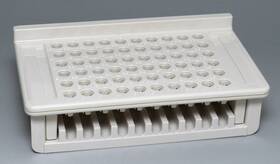
( Brand: Ray Biotech ), ( Manufacturer Part Number: 801-201 ), ( Unit Type: Unit ), ( Intended Use/discipline: Biological Laboratory, Medical Laboratory, Microbiological Laboratory )
Review RAY BIOTECH Magnetic Separation System bead Assays Elisa Etc. 60-position
The RayBiotech 801-201 Magnetic Separation Module is a versatile and essential tool for researchers working with magnetic bead assays, particularly those using enzyme-linked immunosorbent assays (ELISAs). This 60-position magnetic separator is designed to simplify and streamline the process of separating and capturing magnetic beads, thereby improving the overall efficiency and productivity of your laboratory workflow.
This magnetic separation module features 60 individual wells, each with a strong, uniform magnetic field that effectively captures and holds magnetic beads. The wells are engineered with a shallow depth of 1.5 mm, enabling the quick and easy aspiration of supernatants without disturbing the beads. The module is constructed of durable, high-quality materials, ensuring robustness and longevity.
The 801-201 Magnetic Separation Module is compatible with a wide range of magnetic beads commonly used in ELISA assays, including Dynabeads, MagPlex, and other similar bead types. It is also suitable for use with various buffer systems, allowing for flexibility in your experimental design.
The module is designed with a non-stick surface, making it easy to clean and maintain. Additionally, it can be easily integrated with most microplate readers and automated liquid handling systems, allowing for seamless automation of your ELISA workflow.
In summary, the RayBiotech 801-201 Magnetic Separation Module is an indispensable tool for researchers conducting magnetic bead-based ELISAs. Its 60-position design, strong magnetic fields, and compatibility with various bead types and buffer systems make it a versatile and efficient solution for separating and capturing magnetic beads. The non-stick surface and ease of integration with automation systems further add to its convenience and value in your laboratory workflow.
The RayBiotech 801-201 Magnetic Separation System is designed for use in magnetic bead assays, particularly ELISA (Enzyme-Linked Immunosorbent Assay) with 60-position plates. This system automates the process of separating and retrieving magnetic beads from the solution, allowing for faster and more efficient assay processing. Here are some pros and cons of buying this magnetic separation system:
Pros:1. Improved Efficiency: The system's ability to automate the magnetic bead separation process significantly reduces the time and labor required for ELISA assays.
2. Increased Throughput: With a capacity of 60 samples per plate, this system can process a large number of samples in a single run.
3. Consistent Results: The automated process ensures consistent results compared to manual separation methods.
4. Easy to Use: The system is designed to be user-friendly, with a simple workflow and minimal setup required.
5. Compatible with Various ELISA Kits: The system is suitable for use with a wide range of ELISA kits, making it a versatile addition to any lab.
Cons:1. Upfront Cost: The system may have a relatively high upfront cost compared to manual separation methods.
2. Size and Space Requirements: The system requires a dedicated space and may not be suitable for labs with limited benchtop space.
3. Maintenance: The system requires occasional maintenance, including cleaning and filter replacement, to ensure optimal performance.
Conclusion:The RayBiotech 801-201 Magnetic Separation System offers several advantages for labs conducting ELISA assays, including increased efficiency, improved consistency, and higher throughput. However, the system's upfront cost and space requirements may be drawbacks for some labs. Ultimately, the decision to purchase this system depends on the specific needs and resources of the lab.
Recommendation:If your lab conducts a high volume of ELISA assays and requires consistent, efficient results, the RayBiotech 801-201 Magnetic Separation System may be a worthwhile investment. Consider the upfront cost, space requirements, and maintenance needs when making your decision. If your lab's ELISA workload is more modest, manual separation methods may be more cost-effective and appropriate.
Details:
This equipment has a strong magnetic field. Assays cane developed using magnetic beads such as Abrams Magnetic Beads s:// ..us/home/products/magnetic-beads/. The separation unit can be used for a variety of applications including cell sorting, purification of proteins, molecular biology, immunises, etc. This unit was used for product displays at trade shows or demonstrations when selling assays analyzing water algal toxins such as .
The two piece design allows the flexibility for samples to be set up, incubated and magnetically separated without removing tubes from test tube rack. Glass test tubes. The two-piece unit consists of a test tube rack which fits over magnetic separation containing rare earth magnet. For sale is a magnetic separation system designed to hold and separate beads used in ELISA or the side of tubes for up 60 11-13mm diameter.
specifications labequipi:
- brand: Ray Biotech
- mpn: 801-201
- unit type: Unit
- intended use/discipline: Biological Laboratory, Medical Laboratory, Microbiological Laboratory
offer labequipi:
- sold: 0
- options: Ship-to-home
- quantity: 1
- started: July 26, 2025
- availability: In Stock
shipping labequipi:
- carrier: USPS
- service: USPS Priority Mail
- type: Calculated
- transit: 5-11 Days
- cost: $18.35
- class: Expedited
general labequipi:
- Healthcare, Lab Dental > Medical Lab Equipment, Devices > Other Medical Lab Equipment
- condition: Used
seller labequipi:
- # reviews: 67
- city: Lenexa, Kansas
- rating: 100.0%
payments labequipi:
- credit card: Mastercard
- other
- wallet: Google-pay
returns labequipi:
- policy: No Returns
Ray Biotech 801-201 Is Similar To:
- Ge Neral Electric Ray System Ultranet Complete Rad Documented Service (33.1% similar) When unit was pulled everything functioned and worked exactly as it supposed. Table is fully powered has multiple adjustments and foot controls this a high end GE product great machine for either using in the medical field or to use teaching environment university discontinued program item would ...(May 1st, 2018)
- 38042 9896 Veenpluis Philips Foot Pedal For 4-6 X-ray Equipment 000 (26.1% similar) Please refer to the pictures for more details. Philips foot pedal for Nepalis 4/6 x Ray equipment this is untested. Some minor wear and tear is expected on a used item. Item is in good physical condition as pictured. Only pictured items are included cables and other accessories are not included ...(February 29th, 2016)
- Lk-c28 Handheld High Frequency Dental X-ray Unit Digital Imaging System Us (23.8% similar) Frequency: 30KHZ. X-ray unit small size, light weight, easy to carry. Size: 19 14 15CM. The custom LK-C28 is in new condition...(October 8th, 2022)
- Data-ray 800247-002 Data-ray Dr5312 Crt Monitor Control Panel For Hp 77030a As-is (27.4% similar) Manufacturer part number: 800247-002. N/a, item does not include manufacturer/retail box. Power requirements: n/a, there is an internal 4 x 2 asset tag/inventory label on item, this does not impact the items performance. Are not included unless pictured. Functionality: defective see condition. Brand...(September 27th, 2023)
- Ray Foster X150 Paper Dust Bag Filters 10 pk Ref For Cyclone Collector (20.7% similar) Specifically designed to fit the Ray foster X150 model, these filters effectively capture paper dust and other fine particles, ensuring a clean safe working environment. These high-quality filters, sold in a pack of 10, are the perfect addition to keep your collector running at peak performance...(October 14th, 2023)
- Feinfocus Fxe-225.48 Microfocus X-ray System Components Fhg-uc255 6 Generator (28.1% similar) It has a b r automation system 2005 plc. Used as shown. The control cabinet has the Leopold NT12 turbo pump controller with a long cable to attach turbo. ITEM#824121L. As this system is not complete and untested, it sold as-is shown for parts or repair. It is missing the trivia vacuum pump...(August 21st, 2024)
- Air Techniques Scanx-12 A8200 Scanx 12 Digital X-ray Podiatric Imaging System (29.2% similar) Digital x-ray pediatric imaging system. Item location: Portland, or. Condition: used. Guarantee: see for details. Testing: power only. Some items are shipped to Canada and/or overseas. This listing only includes what is shown in the photographs. Part number: A8200. Happy buying. Manufacturer: air ...(December 18th, 2024)
- Ray Foster Cdc1 Cyclone Dust Collector Cdc1 As is For Parts (20.8% similar) Kept in a pet and smoke-free environment. The vacuum is sold as for parts/repair. Guaranteed 100% authentic. Ray foster cyclone dust collector CDC1 as/is. Please examine the photos thoroughly. It is missing the power switch which...(August 18th, 2025)
- Toshiba E7252x Rotanode X-ray Tube R10-t410 Untested For Parts As Is Read Dw (24.4% similar) Please see photos for more details. Toshiba rot anode E7252X x-ray tube R10-T410 untested for parts as is read. Untested, sold as is, fair condition with scratches and dings...(September 5th, 2025)
- Pen Ray D-09462 84035094 Lamp Uv For Pioneer Ps-1 (26.6% similar) For more details, please refer the photos included with listing. Pen Ray D-09462 84035094 lamp UV for pioneer PS-1, new, old stock, PS-1. No other parts/accessories included...(March 20th, 2026)