BIO-RAD HSP3801 Plates Skirted Walled Biorad 384
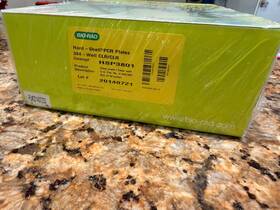
( Brand: Bio-rad ), ( Manufacturer Part Number: HSP3801 ), ( Part Type: Plate ), ( Intended Use/discipline: Biological Laboratory, Microbiological Laboratory )
Review BIO RAD Biorad 384 Hardshell Well Plates Clear Skirted Thin Walled New
The Bio-Rad HS PCR 384-Well Skirted Wall Plate is a high-performance, skirted-walled PCR plate designed for use with real-time PCR systems and other thermal cyclers. This plate is manufactured by Bio-Rad Laboratories, a leading supplier of life science research reagents, tools, and instruments.
The 384-well format of this plate allows for the processing of a large number of samples in a single run, making it an excellent choice for high-throughput applications. Each well is skirted, which helps minimize well-to-well cross-contamination and evaporation, ensuring accurate and reliable results.
The plate is made from polystyrene, which provides excellent optical properties for real-time PCR assays. The skirted walls are transparent, allowing for easy visualization of the sample volume and preventing the risk of sample loss during transfer. The edges of the plate are also flanged, providing extra stability during transfer and handling.
The wells are shallow, with a depth of approximately 0.5 inches, making them suitable for use with low-volume reactions. The plate is also compatible with a wide range of PCR reagents and master mixes, allowing for flexibility in experimental design.
The plate is designed to work with most standard thermal cyclers and real-time PCR systems, including those manufactured by Bio-Rad and other leading suppliers. The skirted walls and flanged edges help prevent sample loss during transfer and ensure proper sealing of the plate during PCR amplification, leading to consistent results.
The Bio-Rad HS PCR 384-Well Skirted Wall Plate is an essential tool for researchers and laboratories working on high-throughput PCR applications, providing excellent performance, reliability, and versatility. Its skirted walls, transparency, and compatibility with a wide range of thermal cyclers make it a valuable addition to any laboratory.
The Bio-Rad HS-3801 384-well Skirted Microplates are commonly used in various laboratory applications, particularly for high-throughput screening assays. Here are some pros and cons of buying these plates:
Pros:1. Skirted design: The skirted design helps prevent sample loss and contamination during the transfer of reagents or plates between different instruments.
2. High-density format: The 384-well format allows for a large number of samples to be processed in a single experiment, increasing throughput and reducing the overall time and cost of the assay.
3. Chemically resistant: The plates are made of high-quality polystyrene material that is resistant to most common laboratory reagents and chemicals, ensuring longevity and durability.
4. Uniform surface: The uniform surface of the plates ensures consistent and reproducible results, which is crucial for high-throughput screening assays.
Cons:1. Cost: The cost per well of these plates can be higher than that of traditional 96-well plates, which may make them less economical for small-scale experiments.
2. Limited compatibility: Some assays, such as those requiring a high level of oxygen or carbon dioxide, may not be suitable for use in these plates due to the skirted design, which can alter the gas exchange properties of the plate.
3. Fragility: The skirted design of these plates can make them more fragile than traditional plates, increasing the risk of damage during handling and transportation.
In conclusion, the Bio-Rad HS-3801 384-well Skirted Microplates offer several advantages for high-throughput screening assays, including a large sample capacity, skirts to prevent sample loss and contamination, and chemical resistance. However, they may not be the most cost-effective option for small-scale experiments, and their skirted design may limit their compatibility with certain assays.
Based on the above, it is recommended that these plates be considered for high-throughput screening assays where large sample volumes need to be processed and where sample loss and contamination are significant concerns. For smaller scale experiments or experiments that require specialized conditions, traditional 96-well plates may be a more cost-effective and suitable alternative.
Details:
I'm selling new and unopened cases of BioRad 384 PCR well plates hard shell, clear HSP3801.
part #: hsp3801 price
- $1200.00
specifications labequipi:
- brand: Bio-rad
- mpn: Hsp3801
- part type: Plate
- intended use/discipline: Biological Laboratory, Microbiological Laboratory
payments labequipi:
- credit card: Discover
- other
- wallet: Apple-pay
general labequipi:
- Healthcare, Lab Dental > Medical Lab Equipment, Devices > Other Medical Lab Equipment
- condition: New
offer labequipi:
- started: September 21, 2025
- best offers: True
- options: Ship-to-home
- availability: In Stock
- sold: 0
seller labequipi:
- city: San Diego, California
- # reviews: 46
- rating: 100.0%
shipping labequipi:
- cost: $0.00
- transit: 5-11 Days
- carrier: USPS
- service: USPS Ground Advantage
- class: Standard
- type: Calculated
returns labequipi:
- policy: No Returns
Bio-rad HSP3801 Is Similar To:
- 0035f Bio Plas Preparation Rack With Covers Wells New (31.6% similar) Tube rack array: 96-WELL 8 x 12 format color: racks are ideal for freezing, bench top use, storage and transporting accommodate. 0ML micro centrifuge tubes or CPR tubes bio pals part number: 0035F...(March 24th, 2019)
- 075t2-s75 Bio-chem 4 New Os Ptfe (21.4% similar) PDF body normally open isolation solenoid liquid gas valves. Used in precision laboratory and scientific equipment where aggressive liquids gases may be present. Chemically inert PDF-Teflon body. 4 new bio-chem valve co. I encourage users to ask any questions related items and will do my best answer...(March 2nd, 2017)
- 1327 Bio-rad Model Econo-recorder Used (32.2% similar) ...(February 20th, 2018)
- 1575 Bio-rad Immunowash Microplate Washer (34.7% similar) Money back guaranteed. Clean, in perfect condition, fully tested, all test passed...(April 30th, 2017)
- 165-1960 Bio-rad 443 Slab Drier (25.2% similar) It powers on and the timer comes with knob. It also seems to warm up very quickly. It only comes with what is shown in the pictures. Bio-rad 443 slab drier catalog no...(January 21st, 2018)
- 165-1965 Bio-rad 483 Slab Dryer (25.2% similar) Domestic shipping: our preferred shipping method is ups ground service unless item too large heavy. Timer controls temperature up to 5 hours this instrument was thoroughly cleaned, quality-tested and comes with 90-DAY warranty. Please if you prefer a specific shipping carrier for updated rate quote...(February 28th, 2017)
- 165-2086 Bio-rad Gene Pulser Cuvette (32.8% similar) 1CM electrode gap biorad d5 hello, you are viewing a listing of product wood man mechanical surplus. They are expected to show some wear as pre-owned. Bio-rad gene pulse Corvette. Exactly what is pictured included. If it is not pictured assume included...(December 1st, 2017)
- 165-5031 Bio-rad Bio Rad Gs (28% similar) No other cords, cables, manuals, accessories, included. Unit is in good working condition. Bio rad gs gene linker UV chamber. Quick reference chart attached on front as shown. Some stains inside chamber as shown. Comes with power cord...(January 30th, 2018)
- 1652087 Bio-rad Bio Rad Capacitance (31.3% similar) Capacitance extender readout cable only. This item has been fully tested by our tech department and is in good working condition...(April 16th, 2017)
- 1652088 Bio Rad Gene Pulser Cuvette Electrode Gap (37.2% similar) Unopened bag of 50. 4CM electrode gap see photos...(August 24th, 2018)
- 1653369 Bio Rad Slighly Used (22.2% similar) ...(May 6th, 2017)