NARISHIGE SM-11 Micromanipulator
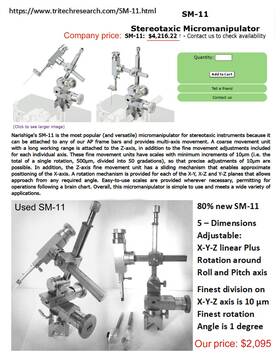
( Brand: Narishige ), ( Manufacturer Part Number: SM-11 ), ( Part Type: Micromanipulator ), ( Unit Type: Unit ), ( Country Of Origin: United States ), ( Intended Use/discipline: Biological Laboratory )
Review NARISHIGE Micromanipulator
The Narishige SM-11 Micromanipulator is a high-precision, manually controlled instrument designed for use in various scientific applications, particularly in microscopy and microsurgery. This device enables researchers and scientists to manipulate and move small specimens with great accuracy and finesse.
The SM-11 Micromanipulator boasts a robust design, with a sturdy base and smooth, reliable movements. Its three-axis control system allows for independent manipulation of the X, Y, and Z axes, providing the user with a high degree of freedom and versatility. Each axis features a fine adjustment knob for precise control, as well as coarse adjustment for larger movements when needed.
The manipulator arm is constructed from high-quality stainless steel, ensuring durability and stability. It is equipped with a fine, tapered glass micropipette holder, which securely and accurately holds microtools or micropipettes. The holder can be easily adjusted in both angle and height, allowing for optimal alignment and approach to the specimen.
The SM-11 Micromanipulator also includes a built-in, adjustable tension control system for the manipulator arm. This feature ensures that the micropipette or tool is held firmly against the specimen during manipulation, preventing unwanted slippage or movement. Additionally, the device is designed to be compatible with various types of micropipettes and microtools, expanding its versatility for a wide range of research applications.
The Narishige SM-11 Micromanipulator is an indispensable tool for researchers and scientists in fields such as embryology, neuroscience, and cell biology. Its high-precision movements, durable construction, and versatile design make it an essential instrument for any laboratory seeking to advance our understanding of the microscopic world.
The Narishige SM-11 micromanipulator is a popular choice for researchers and scientists in various fields, particularly in microscopy and microinjection applications. Here are some pros and cons of buying this micromanipulator:
Pros:1. High Precision: The SM-11 offers high precision and accuracy, which is crucial for microinjection and other micromanipulation applications.
2. Wide Working Range: It has a wide working range, which allows for manipulation of small specimens with ease.
3. Smooth Movement: The micromanipulator provides smooth and stable movement, which is essential for precise manipulation.
4. Versatile: The SM-11 can be used with different microscopes and injection systems, making it a versatile tool for various applications.
5. Durable: The micromanipulator is built to last, with high-quality materials and robust construction.
Cons:1. Expensive: The SM-11 is a high-end micromanipulator, and it comes with a premium price tag.
2. Complex Setup: Setting up the micromanipulator can be a complex process, and it may require some technical expertise.
3. Limited Payload Capacity: The SM-11 may not be suitable for applications that require a large payload capacity.
Conclusion:The Narishige SM-11 micromanipulator is an excellent investment for researchers and scientists who require high precision and accuracy for their micromanipulation applications. Its wide working range, smooth movement, versatility, and durability make it a valuable tool for various microscopy and microinjection applications. However, its premium price tag and complex setup may be a deterrent for some users.
Recommendation:If you are in the market for a high-end micromanipulator for precise microinjection and manipulation applications, the Narishige SM-11 is an excellent choice. Its advanced features and robust construction make it a valuable investment for researchers and scientists in various fields. However, if you are on a tight budget or require a simpler setup, there may be other options available that better suit your needs. Additionally, it is recommended to consult with a technical expert or the manufacturer for any specific setup or application requirements.
Details:
Division in all rotation is 1 degree. These rotations are really helpful when you do vertical advance of electrode into the brain if want to avoid transverse or skittle sinus. In each direction, there are rough and fine scales of adjustment. The whole manipulator can do rotation either around a canter or the frame bar.
The 6-D includes anterior-posterior z, left-right x, ascending-descending y movements plus pitch and roll rotation. The finest division of these movements are 10 um in x-y-z axes.
part #: sm11 price
- $2095.00
specifications labequipi:
- brand: Narishige
- mpn: Sm-11
- part type: Micromanipulator
- unit type: Unit
- country of origin: United States
- intended use/discipline: Biological Laboratory
payments labequipi:
- other
- credit card: Diners-club
- wallet: Apple-pay
offer labequipi:
- sold: 0
- started: May 29, 2026
- options: Ship-to-home
- availability: In Stock
- quantity: 1
- best offers: True
shipping labequipi:
- cost: $9.35
- carrier: USPS
- service: USPS Ground Advantage
- type: Calculated
- class: Standard
- transit: 5-12 Days
returns labequipi:
- policy: No Returns
seller labequipi:
- rating: 0.0%
- # reviews: 0
- city: Cincinnati, Ohio
general labequipi:
- Healthcare, Lab Dental > Medical Lab Equipment, Devices > Other Medical Lab Equipment
- condition: Used
Narishige SM-11 Is Similar To:
- N-a Narishige Hydraulic Axis Micromanipulator (70.1% similar) Narishige hydraulic 3 axis micromanipulator mo condition is used. Discoloration on top but does not affect performance. Shipped with USPS first class package...(October 13th, 2019)
- Narishige 202-nd 202nd Three-axis Joystick Type Oil Hydraulic Fine Micromanipulator (48.7% similar) Narishige 202ND three-axis joystick type oil hydraulic fine micromanipulator - free shipping...(August 5th, 2024)
- Narishige Mm-88 Micromanipulator 3 Axis Joystick (72.5% similar) Up for sale is, 1 - Narishige mm 88 micromanipulator 3 axis joystick, in good working condition, condition...(October 23rd, 2024)
- Narishige Im-16 Model Micromanipulator (85.7% similar) Renowned for its exceptional stability and accuracy, this micromanipulator offers smooth, precise control, making it ideal delicate tasks. The Narishige model IM-16 micromanipulator is a precision instrument designed for meticulous laboratory work. Crafted with high-quality materials, it ensures ...(November 30th, 2024)
- Narishige Mmt-5 Three Tools Alignment Micromanipulator With Magnetic Base (55.2% similar) The tips of three micro tools can be placed adjacent relative to each other so that they approach the specimen simultaneously. Magnetic base and mounting hardware are included. This model includes attachment platform for three micro electrodes. T-5 is a unique 4 axes micromanipulator XS coarse x ...(December 2nd, 2025)